

Stephane Grappelli
- Подробности
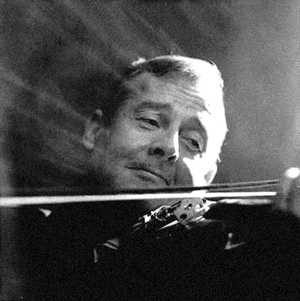
Grappelli was born in Paris, France to Italian parents. Sent to an orphanage as a youth after his mother died when he was 4 and his father left to fight in World War I, Grappelli started his musical career busking on the streets of Paris and Montmartre with a violin. He began playing the violin at age 12, and attended the Conservatoire de Paris studying music theory, between 1924 and 1928. He continued to busk on the side until he gained fame in Paris as a violin virtuoso. He also worked as a silent film pianist while at the conservatory and played the saxophone and accordion. He called his piano "My Other Love" and released an album solely playing piano of the same name. His early fame came playing with the Quintette du Hot Club de France with Reinhardt, which disbanded in 1939 due to World War II.
Post-war
After the war he appeared on hundreds of recordings including sessions with jazz pianists Oscar Peterson and Claude Bolling, jazz violinist Jean-Luc Ponty, jazz violinist Stuff Smith, Indian classical violinist L. Subramaniam, vibraphonist Gary Burton, pop singer Paul Simon, mandolin player David Grisman, classical violinist Yehudi Menuhin, orchestral conductor Andre Previn, guitar player Bucky Pizzarelli, guitar player Joe Pass, cello player Yo Yo Ma, harmonica and jazz guitar player Toots Thielmans and fiddler Mark O'Connor. He also collaborated extensively with the British guitarist and graphic designer Diz Disley, recording 13 record albums with him and his trio. He also collaborated extensively with now renowned British guitarist Martin Taylor. In the 1980s he gave several concerts with the young British cellist Julian Lloyd Webber.
In 1997, Grappelli received the Grammy Lifetime Achievement Award.
Grappelli is interred in Paris' famous Pere Lachaise Cemetery.
Quotations
* "In the cinema, I had to play Mozart principally but was allowed some Gershwin in funny films. Then I discovered jazz and my vocation and kissed Amadeus goodbye."
—on his transition from silent film pianist to jazz violinist.
* "Improvisation, it is a mystery. You can write a book about it, but by the end no one still knows what it is. When I improvise and I'm in good form, I'm like somebody half sleeping. I even forget that there are people in front of me. Great improvisers are like priests, they are thinking only of their God."
* "Retirement! There isn't a word that is more painful to my ears. Music keeps me going. It has given me everything. It’s my fountain of youth."
Recordings
Note: This is by far not complete as many of his recordings were not transferred to compact disc, and some of his other discs are compilations: e.g. Piano record, Diz Dizley, Bucky Pizzarelli.
* Improvisations (Paris, 1956)
* Djangoly: Django Reinhardt the gypsy genius (1936 to 1940)
* Stephane Grappelli and Django Reinhart the Gold Edition (1934 to 1937, copyright 1998)
* Stephane Grappelli 1992 Live (1992, Verve)
* Stephane Grappelli in Tokyo (1991, A & M records)
* Just One Of Those Things (1984, EMI Studios)
* Stephane Grappelli Live at the Blue Note (1996, Telarc Jazz)
* Bill Coleman with Django and Stephane Grappelli 1936 to 1938 (released 1985, DRG Records)
* Fascinating Rhythm (1986, Jazz Life)
* Parisian Thoroughfare (1997, Laserlight)
* Martin Taylor Reunion (1993, Linn Records)
* The Intimate Grappelli (1988, Jazz Life)
* Jazz Masters (20+-year compilation, 1994, Verve)
* Michelle Legrand (1992, Verve)
* Oscar Peterson Skol (1979, released 1990 Pablo)
* Homage To Django (1972, released 1976 Classic Jazz)
* Bach to the Beatles (1991, Academy Sound)
* Stephane Grappelli Plays Jerome Kern(1987, GRP)
* How Can You Miss, with Louis Bellson and Phil Woods (1989, Rushmore)
* Young Django (1979, MPS)
* Live in San Francisco (1986, Blackhawk)
* 85 and Still Swinging (1983, Angel)
* Vintage 1981 (1981, Concord)
* Jean-Luc Ponty Violin Summit (1989, Jazz Life)
* Martin Taylor: We've Got The World on a String (1984, EMI)
* Stuff Smith: Violins No End (1984, Pablo)
* Sonny Lester Collection (1980, LRC)
* Stephane Grappelli and Joe Venuti: Venupelli Blues (1979, Affinity)
* Shades of Django (1975, MPS)
* Afternoon in Paris (1971, MPS)
* Live at Carnegie Hall (1978, Signature)
* Jazz 'Round Midnight (1989, Verve)
* Unique Piano Session Paris 1955 (1955, Jazz Anthology)
* Stephane Grappelli and Cordes (1977, Musidisc)
* Satin Doll (1975, Vanguard)
* Manoir de Mes Reves (1972, Musidisc)
* Grappelli Plays George Gershwin (1984, Musidisc)
* Stephane Grappelli (PYE)
* Diz Disley Live at Carnegie Hall (1983, Dr Jazz)
Collaborations with other artists
* Stephane Grappelli and Claude Bolling: First Class (1992, Milan)
* Stephane Grappelli and Gary Burton: Paris Encounter (1972, Atlantic)
* Stephane Grappelli and Hubert Clavecin: Dansez Sur Vos Souvenirs (Musidisc)
* Stephane Grappelli and David Grisman Live (1981, Warner Brothers)
* Stephane Grappelli and Barney Kessel: Remember Django (1969, Black Lion)
* Stephane Grappelli and Barney Kessel: Limehouse Blues (1972, Black Lion)
* Stephane Grappelli and Yo Yo Ma: Anything Goes (1989)
* Menuhin and Grappelli Play Berlin, Kern, Porter and Rodgers & Hart (1973 to 1985, EMI)
* Stephane Grappelli and Yehudi Menuhin: Jalousie (1975, EMI)
* Stephane Grappelli and Helen Merrill (1986, Music Makers)
* Stephane Grappelli and Oscar Peterson (1973, Musicdisc)
* Stephane Grappelli and Jean-Luc Ponty: Compact Jazz (1988, MPS)
* Stephane Grappelli and The George Shearing Trio: The Reunion (1977, MPS)
* Stephane Grappelli and Martial Solal (1980, MPO)
* Stephane Grappelli and Martial Solal: Olympia 1988 (1988, Atlantic)
* Stephane Grappelli with Marc Fosset Stephanova (Concord Jazz, 1983)
* Stephane Grappelli and L. K. Subramaniam: Conversations (1992, Milestone)
* Stephane Grappelli and Toots Thielemans: Bringing it Together (1984, Cymekob)
* Stephane Grappelli and Joe Venuti: Best of Jazz Violins (1989, LRC)
* Violin Summit: Stephane Grappelli, Stuff Smith, Svend Asmussen, Jean-Luc Ponty (1967, Polygram)
* Stephane Grappelli and Baden Powell: La Grande Reunion (1974, Accord)
* Stephane Grapellli and Paul Simon "Paul Simon" (9) 1972 Hobo's Blues (Columbia 1972)
Stephane Grappelli,
1908-1997
BY STACEY KORS | "I am like a shark," Stephane Grappelli once said. "I won't stop. I will play until the final curtain." Sadly, that curtain fell on Monday, when the legendary French jazz violinist died in a Paris clinic from complications following a hernia operation. Although 89 years old, Grappelli kept to his word: He gave his last concert only a few months ago.
It may sound trite to refer to a popular artist as being "beloved" by his fans. But if there were ever one genuinely deserving of such a description, it was surely Grappelli, who was to the jazz violin what Vladimir Horowitz was to the classical piano. With his lively, elegant swing style, his colorful shirts and spirited smile and a youthful exuberance that lasted through eight decades of live performance and an unparalleled 100-plus recordings, Grappelli won the hearts of music lovers on both sides of the Atlantic.
Born in Paris on Jan. 25, 1908, Grappelli started teaching himself to play the violin at the age of 13, when his father, a philosophy professor, brought him a second-hand instrument. At 15, he was helping to pay the bills by working as a piano accompanist for silent films. Grappelli later got a job playing piano with a French show band, but when the band leader heard him playing the violin one night, he encouraged Grappelli to devote himself fully to that instrument.
Initially, Grappelli struggled to get people to accept his attempts at playing jazz music on a traditionally classical instrument. After several years of performing to lukewarm reception in restaurants and cafes, he met up with gypsy guitarist Django Reinhardt and began playing with him. Their late-night jam sessions, which included bassist Louis Vola and guitarists Roger Chaput and Reinhardt's brother Joseph, so impressed top French critics that they made the group the official combo of their jazz society, the Hot Club. The unconventional, all-string Quintet of the Hot Club of France became the most influential and popular European jazz band of the mid-to-late '30s. Through his work with the Hot Club, Grappelli helped to put jazz violin on the map, setting the stage for later talents such as John Blake and jazz fusion artist Jean-Luc Ponty.
Although World War II broke up the quintet, Grappelli, who was in England at the time, continued to play with a series of small groups. In the decades that followed, he toured extensively with a quintet similar to the Hot Club, devoting himself mainly to the romantic melodies of the great American songwriters George Gershwin, Jerome Kern and Cole Porter. Even in the age of bebop, this was the music that spoke to him; he, in turn, made it speak to his audience, performing it with his smooth, lyrical, swing technique.
Some of Grappelli's best-known ventures were collaborations with other artists. Through the years, he played and/or recorded with dozens of the great legends of jazz, including Duke Ellington, Coleman Hawkins, Joe Venuti, Oscar Peterson, George Shearing, Joe Pass, Earl Hines, Quincy Jones, McCoy Tyner, Bill Coleman and Hank Jones. What many fans of Grappelli don't know, however, is that the grandfather of jazz violin was trained as a classical musician -- first at the Isadora Duncan school and later at the Paris Conservatory. But when Grappelli heard his first Louis Armstrong recording at the age of 19, everything changed. "I discovered jazz and my vocation," he said, "and kissed Amadeus goodbye."
But that didn't keep Grappelli from having an influence on some of the late-20th century's most celebrated classical string players. In the 1970s, Grappelli formed a popular partnership with violinist Yehudi Menuhin that resulted in six albums. Menuhin, who was a great admirer of Grappelli's improvisational skills, once remarked that "Stephane is like one of those jugglers who send 10 plates into the air and recovers them all."
More recently, Grappelli performed and recorded with cellist Yo-Yo Ma, as well as bad-boy British violinist Nigel Kennedy, whose new CD, "Kafka," features the octogenarian artist in what is presumably his final recording. The gypsy-jazz quality of some of the tracks on "Kafka," all of which were composed by Kennedy, are strikingly reminiscent of Grappelli's early work with Reinhardt.
It seems that retirement was never an option for Grapelli. Even after a string of illnesses in the mid-1990s, he continued to perform, and was even planning a tour next year in honor of his 90th birthday. "Music keeps me going," he explained. "It has given me everything." Looking over his remarkably long and fruitful career, it's fair to say that Grappelli gave it all back.
SALON | Dec. 3, 1997
Stacey Kors is a music writer whose work has appeared in Newsday, Stagebill and the New York Press.
Main menu
Anthology
Sheet Music Archive
 lesson 1lesson 2lesson 3